
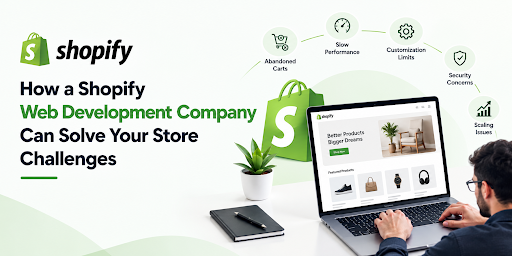
How a Shopify Web Development Company Can Solve Your Store Challenges

Written by Jack Devis
Starting an online store feels simple, at first. Then you end up doing a lot in the same week. You handle product listings, talk to customers, deal with payments, plan marketing, and think about mobile shoppers. On top of that, you keep up with SEO work and update pages every day.
A lot of people begin with a basic site. For a while, it is fine. Then the traffic grows, and issues show up.
The website may load slowly. Customers may struggle to find products. The checkout may create friction. Your marketing team may depend on developers for every small change. At the same time, you may spend money on advertising without getting enough sales.
This is where a shopify web development company can help.
As per my research, Shopify has become a major ecommerce platform. Shopify says millions of sellers in over 175 countries use its platform. It also says Shopify sellers made $378 billion in GMV in 2025. The company adds that total GMV has topped $1.6 trillion since Shopify launched. Taken together, these figures suggest Shopify can handle business at a big scale.
But the platform alone does not solve every store problem. You still need the right structure, design, features, integrations, and strategy.
The Problem: Your Shopify Store May Not Support Your Growth
I keep noticing ecommerce shops chase traffic numbers, but they skip the hard part: checking if the site can turn clicks into purchases. Picture a buyer tapping your ad. They land on the product page, scan it for a moment, and then bounce. The page does not clear up the main questions, so they do not buy.
You paid to bring them in, yet you walked away with no sale.
This creates a bigger problem.
You may start spending more money on Google Ads. You may invest in SEO. You may publish more content. You may even hire a google ads management company to improve your campaigns. But if your website creates friction, your marketing budget can still produce weak results.
As per my research, ecommerce success depends on more than traffic. Your site should cover the whole customer path, starting with the first visit, then to checkout, and later on repeat buys.
If you run a Shopify store, it should help shoppers figure out what you sell, weigh their choices, feel safe buying from you, and finish the order.
The Agitation: More Traffic Cannot Fix a Weak Store
Imagine spending ₹1 lakh on advertising and bringing thousands of visitors to your store. Your traffic numbers look good, but your sales do not move in the same direction.
What happens next?
You may blame the ads. Then you may blame the SEO. Then you may reduce your product prices.
But the actual problem may sit inside the website.
When people cannot move around a site easily, they often struggle to locate items. If the product text is not clear, shoppers may still have unanswered questions. If the mobile layout is sloppy, it can feel awkward to shop. Too many apps can create technical problems. A complicated checkout can make customers leave before completing the order.
As I found over research, these problems become more serious when a business grows. A store that worked for 50 products may not work as well when you manage hundreds or thousands of products.
Your team might sit idle while developers handle small changes.
If marketing has to ask a developer every time it wants a new banner, a landing page, an updated collection, or a new promotion, you slow down the whole business.
That lost time can affect campaigns, product launches, and customer experience.
The Solution: Custom Shopify Development
This is where a trusted shopify web development company can change the way your store works.
A professional development team can study your current website, identify technical problems, understand your business goals, and then create a Shopify store around your actual needs.
I believe custom development does not mean adding hundreds of features. It means adding the right features.
For one business, custom product filters may matter most. For another, the business may need subscriptions, advanced product pages, customer accounts, ERP integration, inventory management, or custom landing pages.
From what I have seen while reading ecommerce case studies, teams often get better results when they start with the business issue. They do not always benefit just by shipping more technical features.
For a solid Shopify build, you also need to pay attention to how it looks on phones. You should check how fast pages load. Make sure the site is set up for SEO. Track the right data with analytics. Review the checkout steps. Confirm that apps and integrations work. Plan for what the store might need later.
A Real Shopify Case Study Shows What Better Development Can Do
I found one case study that stood out while I was looking through research materials. It involved Bombay Shaving Company.
At first, the brand ran on a custom built commerce setup. Later, it switched to Magento. After that, the company hit a few issues as both the catalog and the audience kept expanding. It dealt with slow updates on the site, heavy technical upkeep, and delays in getting new features out.
In 2021, Bombay Shaving Company made another move. This time, it adopted Shopify.
Shopify says that after the switch, online revenue rose by 20 times. It also notes a 150% improvement in conversion rate versus how the site performed before Shopify. The company reported a 4 times increase in average order value. It also managed traffic spikes up to 20 times, with more than 10,000 people on the site at once, and the experience stayed stable.
The company handles over 300 SKUs today and also runs seven D2C brands. It set this up through Shopify expansion stores. Shopify says the stores took in more than 50,000 orders across two days when big sales events hit.
I would not treat these figures as a guarantee for every Shopify store. Stores vary a lot. Products, customer bases, ad spend, and local demand all differ.
Still, the case study data makes one point clear. When you pick the right ecommerce platform and build it the right way, you can cut through technical issues faster.
Your Marketing and Website Should Work Together
Your website should not operate separately from your marketing strategy.
When you choose a white label SEO provider, their crew can handle technical SEO, page content, keyword planning, and help your pages show up in search results.
If you pay for link building, they can help you earn more references from other sites. That can strengthen trust and make it easier to attract natural traffic.
You can also work with a Google Ads management firm. They can bring in visitors through ads that match your target audience.
But all of that traffic needs a strong website.
As per my research, this is where many businesses miss the bigger picture. They treat development, SEO, advertising, and conversion optimisation as separate activities.
I see them as connected parts of the same customer journey.
SEO helps people discover you. Ads help you reach people faster. Link Building can support your authority. Shopify development helps create the experience that turns visitors into customers.
If one part fails, the other parts can lose value.
Custom Shopify Development Can Save Your Team Time
Another major store challenge involves daily operations.
Your marketing team should not need technical support for every basic website change.
Shopify gives businesses tools that allow non-technical teams to manage many store activities themselves. Bombay Shaving Company’s Shopify case study shows this clearly. After moving to Shopify, its teams could create product pages in hours instead of weeks and manage merchandising and page updates with less dependence on technical resources.
As I found over research, speed matters when you run ecommerce campaigns.
If a new product takes weeks to publish, you may miss demand. If your team can make approved changes quickly, you can test offers, update pages, and respond to customer behaviour faster.
That can make a real difference when competitors can launch similar products quickly.
The Future of Shopify Stores Is More Connected
I believe the future of ecommerce will involve more connected systems.
Your Shopify store will need to work with advertising platforms, SEO tools, customer data, payment systems, inventory software, analytics, email marketing, and other business systems.
Shopify’s current scale supports this direction. The firm says it has millions of merchants in over 175 countries. It also lists more than 21,000 apps in its network. In its 2025 report, it claims it holds over 14% of the US online shopping market.
So for many businesses, this setup can offer wide reach. Even so, teams still have to pick the right steps for their own goals.
You do not need every app. You do not need every new feature. You need the tools that solve your actual business problems.
From my time looking into ecommerce strategy, I found the best way to build is to ask one basic thing. What stops people from buying right now?
After you figure that out, you can tell what your Shopify store actually needs.
A Better Shopify Store Starts With the Right Development Partner
Your Shopify store is meant to speed things up, not add extra tasks.
If shoppers cannot find what they need, or if your team keeps waiting on fixes and updates, then the setup may not be working well.
You may also want to look again if your ads bring visitors but sales do not follow.
A reliable shopify web development company can help you identify those problems and build practical solutions.
At the same time, you can strengthen the results through SEO, white label seo services, Link Building, and professional advertising support from a google ads management company.
As per my research, the real goal should not be to build the most complicated Shopify store. Your store should feel solid for both shoppers and your own team.
That kind of setup usually brings quicker changes, easier browsing, and product pages that actually help people. Checkout should move without friction. Marketing links should fit in the right way, not bolt on. All of that should also leave room for what you will need later as you grow.
Shopify can provide the foundation. The right development strategy can turn that foundation into a store that supports your business.
Enjoyed Reading? Wait! There’s More For You.
How a Shopify Web Development Company Can Solve Your Store Challenges
Rashes That Look Like Ringworm But Aren’t
How Safe Are Peptides for Weight Loss and Fat Reduction?
How Ongoing Charity Creates Lasting Change in Communities
Why Do Subscribers Ignore Your Email Marketing Efforts?
How Fast Food Packaging Boxes Improve Food Safety and Presentation
Written by Jack Devis
Meet Jack, a creative writer behind SonicMenuGuide.com. With a deep love for fast food, Jack enjoys scrabbling into the world of Sonic cuisine. Now, passionately sharing his unique experience and helping others to discover the hidden gems of Sonic. With a keen commitment to analyzing ingredients, pricing, and calorie information, Jack’s Write ups empower you to make informed choices.