
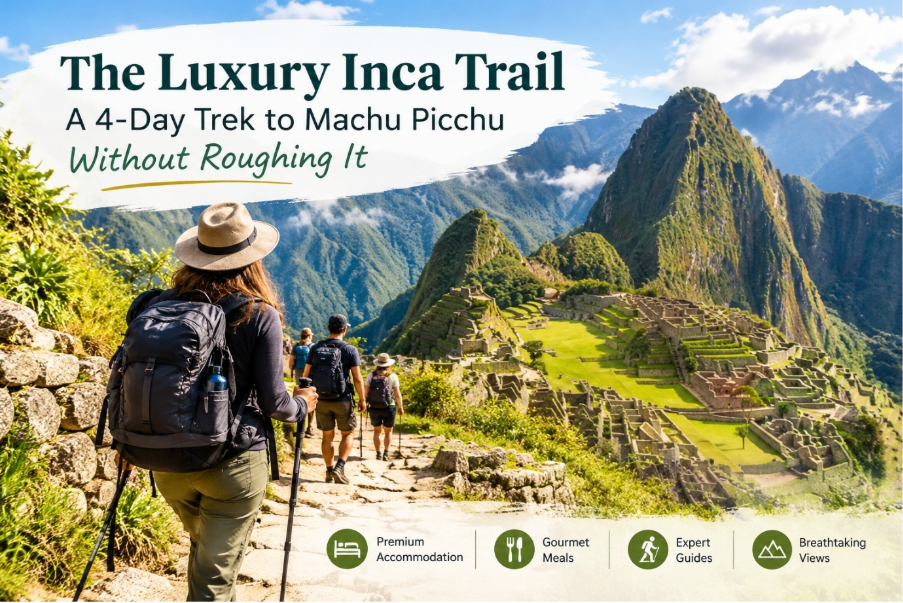
The Luxury Inca Trail: A 4-Day Trek to Machu Picchu Without Roughing It
Written by Jack Devis
There’s a particular kind of fatigue that sets in by the third day of a long trek — the kind where your shoulders remember every strap, your knees have opinions about the word “descent,” and all you want is a bed that isn’t a sleeping bag. The luxury Inca Trail exists for people who want the four days of mountain air, Incan stonework, and that first glimpse of Machu Picchu through the clouds, without that particular kind of fatigue tagging along.
This isn’t a different trail. It’s the same 26-mile route through the Sacred Valley, the same Dead Woman’s Pass gasping for breath at 13,828 feet, the same descent through cloud forest into Aguas Calientes. What changes is everything around the walking: who’s carrying your gear, what’s waiting at camp, and how much energy you have left to actually look up and notice where you are.
If you’re weighing a Luxury Inca Trail 4 days to Machu Picchu against the standard group trek, this guide walks through what’s genuinely different, what to expect day by day, and who this kind of trip actually makes sense for.
What “Luxury” Actually Means on This Trail
It’s a word that gets thrown around loosely in trekking marketing, so it’s worth being specific. On the Inca Trail, luxury almost never means a hotel-style tent with a real mattress pitched next to ancient ruins — the terrain and Peru’s park regulations don’t allow anything close to that. What it does mean is a meaningful upgrade in three areas: sleeping comfort, food, and group size.
A standard trek typically puts eight to sixteen trekkers in a group, sleeping on thin foam pads in basic dome tents, eating well but simply, and sharing a couple of guides across the whole group. A luxury operator trims that group down to somewhere between two and eight people, swaps the foam pad for an inflatable mattress or cot, and brings along a dedicated chef rather than a camp cook working from a single communal menu. Some operators also upgrade the toilet tents — which, four days in, matters more than people expect going in.
The porters-to-trekker ratio tends to be higher too, which isn’t just about comfort. It means camp is usually set up and meals are ready before you arrive, rather than you waiting around in the cold while tents go up.
Day-by-Day: What the Route Actually Looks Like
Day 1: Km 82 to Wayllabamba
The trek starts at kilometer 82 of the railway line, where your permit gets checked and the trail officially begins. This first day is deceptively gentle — mostly flat or gently rolling, following the Urubamba River before climbing slightly toward the village of Wayllabamba. It’s a good day to pace yourself rather than prove anything; the real climbing starts tomorrow, and burning out on day one because the terrain felt easy is a mistake even fit hikers make.
Along the way you’ll pass the ruins of Llactapata, a good first stop for photos with the Urubamba valley spread out behind you. Luxury groups often linger here longer than standard groups, since there’s less pressure to keep pace with a larger group further back on the trail.
Day 2: Wayllabamba to Pacaymayo — Dead Woman’s Pass
This is the day people worry about beforehand and remember afterward. You’ll climb roughly 1,200 meters to Warmiwañusca, better known as Dead Woman’s Pass, the highest point on the trail at 4,215 meters. It’s steep, it’s long, and the air gets noticeably thinner with every switchback.
What a luxury trek changes here isn’t the climb itself — gravity doesn’t negotiate — but the pacing and support around it. Smaller groups mean your guide can actually match your speed rather than herding sixteen people at the pace of the slowest hiker. Lunch is often set up partway up or just past the pass rather than hours away at camp, which matters more than it sounds like it would when your legs are done.
A practical note: the climb up Dead Woman’s Pass usually feels worse in anticipation than in execution. It’s slow, steady, and the altitude makes everything feel heavier than the gradient alone would suggest — but it’s rarely technical. The descent on the other side, down uneven stone steps, is often harder on the knees than the climb was on the lungs.
Day 3: Pacaymayo to Wiñay Wayna
Often called the best day on the trail, and it’s hard to argue. You’ll cross a second and third pass, pass through cloud forest, and walk by several archaeological sites — Runkurakay, Sayacmarca, and Phuyupatamarca among them — with far fewer crowds than Luxury Inca Trail 4 days to Picchu itself will have. This is also the day the landscape shifts noticeably, from high alpine terrain into subtropical cloud forest, with orchids and hummingbirds replacing the scrubby grass of the pass.
Luxury camps on this stretch tend to be set at Wiñay Wayna, close enough to the Sun Gate that the final morning’s walk is short. Some operators use this last night to serve a celebratory dinner, which, after two days of serious elevation gain, tends to land well with most groups.
Day 4: Sun Gate to Machu Picchu
An early start — often a 3:30 or 4 a.m. wake-up — gets you to the checkpoint before the gate opens, so you can reach Inti Punku, the Sun Gate, as close to sunrise as weather allows. On clear mornings, this is the payoff: Machu Picchu hiking tours appearing below in the early light, before the first trains of day-trippers arrive. On cloudy mornings, which happen more often than guidebooks let on, the city reveals itself gradually as the mist burns off — which has its own kind of drama.
From there it’s a roughly 90-minute walk down into the site itself, followed by a guided tour of Machu Picchu before the afternoon crowds build.
Who This Trek Is Actually For
It’s worth being honest here: the luxury version doesn’t make the trail easier. The elevation gain, the altitude, and the distance are identical to the standard trek. What it changes is recovery, privacy, and the quality of downtime between walking segments.
This version tends to suit travelers who want more personal space and a slower, more conversational pace with their guide; those on a honeymoon or milestone trip who’d rather not share a dining tent with a dozen strangers; and hikers who are reasonably fit but not especially experienced with multi-day treks, since the extra support cushions a lot of the logistical stress that trips people up.
It makes less sense for budget-conscious backpackers, large groups who enjoy the social energy of a bigger trekking party, or anyone expecting the comfort level to erase the physical demands of the hike. No amount of camp upgrades changes the fact that day two still climbs 1,200 meters.
What’s Actually Included
Specifics vary by operator, but a well-run Luxury Inca Trail package typically covers:
- Entrance permits (these are capped at 500 per day and sell out months in advance)
- A private or small-group guide, usually one for every four to six trekkers
- A dedicated trekking chef, with meals built around dietary restrictions rather than a fixed menu
- Inflatable sleeping pads or cots, often with better-insulated sleeping bags
- Larger, more private sleeping tents, sometimes with two-person-only arrangements even for couples traveling with friends
- Porter support for both camp gear and, often, a daypack service
- A final-night hotel stay in Aguas Calientes rather than an early train back
That last point matters more than it might seem — ending the trek with a hot shower and a real bed before the train or flight home changes how the whole trip is remembered.
Acclimatization and Fitness: What to Actually Expect
Altitude, not distance, is what breaks most people on this trek. Four days isn’t long in trekking terms, but starting around 2,800 meters and climbing well above 4,000 means your body is working harder for the same effort than it would at sea level. Most operators recommend arriving in Cusco two to three days early to acclimatize before starting — this isn’t a formality, it’s the single biggest factor in how enjoyable the trek feels.
Fitness-wise, you don’t need to be a serious athlete, but regular cardio in the weeks beforehand makes a real difference, particularly on stairs or inclines, since a lot of the trail’s elevation change happens on uneven stone steps rather than smooth trail. Expect your legs to feel the descents more than the climbs — downhill walking on stone steps for hours is genuinely harder on the joints than it sounds.
Best Time of Year to Trek
The dry season, roughly May through September, offers the clearest skies and most reliable trail conditions, though it’s also the busiest and coldest at night. Shoulder months — April and October — often strike a good balance: fewer crowds, decent weather, and slightly easier permit availability. The trail closes entirely every February for maintenance, so that month is off the table regardless of operator.
Booking Timing
Because permits are capped and tied to specific departure dates, Inca Trail permits for popular months routinely sell out four to six months in advance — sometimes earlier for luxury departures, since those groups are smaller and fill faster per available slot. If you have a fixed travel window, booking early isn’t optional so much as the only way to guarantee a spot.
Frequently Asked Questions
Is the Luxury Inca Trail actually easier than the standard trek?
No — the physical route, distance, and elevation gain are identical. What’s different is the support and recovery around the hiking itself, not the hiking.
How much more does a luxury trek cost compared to a standard group trek?
Luxury departures typically run two to four times the cost of a standard group trek, largely due to smaller group sizes, dedicated staff, and upgraded gear and meals.
Do I need prior trekking experience?
No, but reasonable cardiovascular fitness and some experience walking on uneven terrain for multiple hours a day will make the experience considerably more enjoyable.
How many people are typically in a luxury Inca Trail group?
Most luxury operators cap groups between two and eight trekkers, compared to eight to sixteen on standard departures.
What’s the hardest part of the 4-day trek?
The climb to Dead Woman’s Pass on day two is the most physically demanding section, both for the elevation gain and the altitude.
When should I book if I want a specific date?
Four to six months ahead is a safe minimum for popular season dates, given Peru’s daily permit cap of 500 trekkers, including guides and porters.
Can I customize meals on a luxury trek?
Yes — this is one of the more consistent upgrades, since luxury operators generally travel with a dedicated chef able to accommodate vegetarian, vegan, and most allergy-related requests.
Is the final day’s hike to Machu Picchu included, or is it separate?
It’s part of the same permit and route — day four ends with the walk through the Sun Gate and into the Machu Picchu site itself, followed by a guided tour.
Enjoyed Reading? Wait! There’s More For You.
The Luxury Inca Trail: A 4-Day Trek to Machu Picchu Without Roughing It
Umrah for Women: A Practical Guide for Sisters Travelling from Britain
H1: Business Logo Design: How to Create a Logo That Actually Works for Your Brand
Peptide Education: A Complete Guide to Learning Peptide Science
Creative Custom Happy Meal Box Designs For Your Business
Donut Boxes: Essential Packaging for Freshness and Branding
Written by Jack Devis
Meet Jack, a creative writer behind SonicMenuGuide.com. With a deep love for fast food, Jack enjoys scrabbling into the world of Sonic cuisine. Now, passionately sharing his unique experience and helping others to discover the hidden gems of Sonic. With a keen commitment to analyzing ingredients, pricing, and calorie information, Jack’s Write ups empower you to make informed choices.