
The 2 Day Inca Trail to Machu Picchu: What to Expect on Peru’s Shortest Classic Trek

Written by Jack Devis
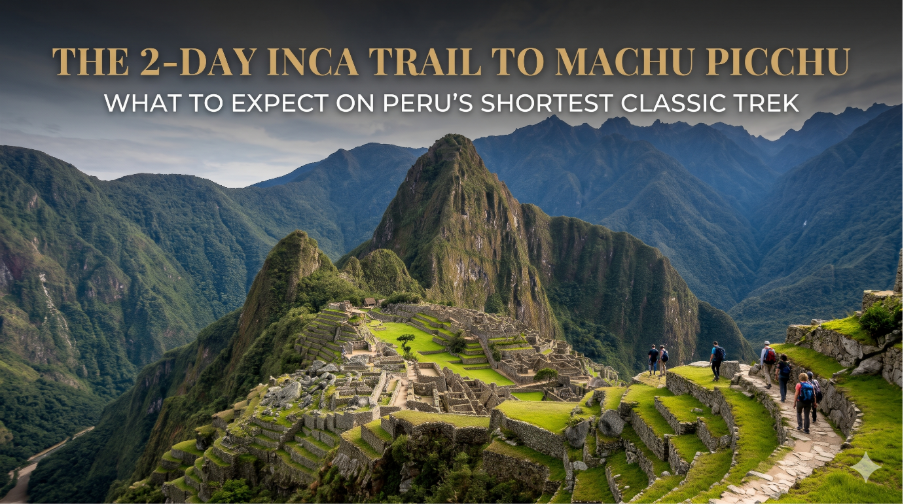
The train rattles along the Urubamba River, and somewhere past the window the valley walls start closing in, green and steep, with clouds sitting low enough to touch the ridgelines. This is where most people get their first real sense that Machu Picchu isn’t just a postcard — it’s tucked into a landscape that fights you a little before it lets you in. For travelers who don’t have a week to spare but still want to earn their view of the citadel on foot, the 2 Day Inca Trail to Machu Picchu is the answer. It’s shorter, yes, but it’s not a shortcut in the way people assume.
This version of the trail skips the multi-day push over mountain passes that the classic route is known for, but it keeps the parts that actually matter: original Inca stonework, cloud forest, and that first glimpse of Machu Picchu through the Sun Gate. If you’re deciding between hiking options and wondering whether the condensed route delivers a real trekking experience, here’s what it actually looks like on the ground.
What the 2 Day Inca Trail Actually Involves
Unlike the 4 day classic trek, this route doesn’t start at Kilometer 82. Instead, hikers board a train toward Kilometer 104, a small checkpoint along the railway where the trail officially begins. From there, it’s roughly 11 kilometers of hiking — compact, but far from flat.
The path climbs through subtropical forest, past orchids and hanging moss, before reaching Wiñay Wayna, one of the most impressive archaeological sites along the entire trail network. Many longer-trek hikers only see Wiñay Wayna on their final morning, exhausted and racing the clock. On the 2 day route, you arrive with more energy and, often, better light for photos.
From there, the trail connects to the same final stretch used by the classic trek — the one that ends at Inti Punku, the Sun Gate, with Machu Picchu spread out below.
How It Compares to the Classic 4 Day Trek
This is usually the first question people ask, and it deserves an honest answer rather than a sales pitch.
What you get: the Sun Gate arrival, access to Wiñay Wayna, genuine Inca trail tread underfoot, and the psychological payoff of walking in rather than riding a bus up from Aguas Calientes.
What you don’t get: the high-altitude passes like Dead Woman’s Pass, the broader variety of ecosystems, and the slower, more immersive pacing that comes with camping for multiple nights in the mountains.
If your priority is maximum scenery and a deeper wilderness experience, the 4 day trek wins. If your priority is doing an authentic hike without committing a week of vacation time — or without months of advance permit planning — the shorter route is the more realistic option for a lot of travelers. Neither one is “the better trek” in absolute terms; it depends on what you’re optimizing for.
Day-by-Day Breakdown
Day 1: You’ll typically take an early train from Ollantaytambo toward Kilometer 104. After a permit check at the control post, the hike begins with a steady uphill push — nothing technical, but enough incline to get your heart rate up within the first twenty minutes. The trail levels out through forest sections before the final approach to Wiñay Wayna, where most groups stop to explore the terraces before continuing to Aguas Calientes for the night.
Day 2: This is an early start — often before sunrise — to reach the Sun Gate before the crowds arriving by bus from town. The walk from the overnight stop to Machu Picchu itself takes a few hours, with the final approach along original Inca steps. Reaching Inti Punku and seeing the citadel appear below, usually with mist still clinging to Huayna Picchu, tends to be the moment people say made the whole trip worth it.
Fitness, Altitude & What the Climb Actually Feels Like
You don’t need to be an athlete, but you do need reasonable fitness and, more importantly, acclimatization. Most of this route sits at a lower elevation than the high passes on the 4 day trek, which is part of why it’s popular with travelers who are short on time or nervous about altitude. Still, arriving in Cusco (over 3,300 meters) a couple of days early to adjust will make the hike noticeably easier.
A few honest observations from the trail:
- The uphill sections near the start are the most demanding part — your legs will know they’re working, even if the distance seems short on paper.
- Stone steps, especially uneven ones near Wiñay Wayna, are harder on the knees going down than going up.
- Weather shifts fast. A clear morning can turn misty by midday, so layers matter more than people expect.
- The best photo light at the Sun Gate is early morning, which is another reason the predawn start is worth the lost sleep.
If you can comfortably walk several hours on uneven terrain without needing frequent long breaks, you’ll be fine.
Permits, Timing & Booking Window
Permits for any Inca Trail route, including the 2 day option, are limited and issued by the Peruvian government. They sell out faster than most people expect, particularly during the June through August high season. Booking two to four months in advance is a reasonable buffer for most travel dates; during peak months, earlier is safer.
The trail closes entirely every February for maintenance, so that month is off the table regardless of which version you’re considering. Shoulder season months — April, May, September, and October — tend to offer a good balance of manageable crowds and drier weather.
Packing & Practical Trail Tips
You’re only out for two days, but the gear list still matters:
- Footwear: broken-in hiking shoes or boots — this is not the trip to test new shoes
- Layers: a light rain jacket, a warm layer for the morning climb to the Sun Gate, and a breathable layer for the uphill sections
- Daypack essentials: water, sun protection, your passport (required at trail checkpoints), and snacks for the trail
- Camera consideration: pack it somewhere accessible — you won’t want to be digging through a bag when the citadel comes into view
Most operators handle entrance tickets, train transport, and one night’s accommodation in Aguas Calientes, so packing stays fairly light compared to a multi-day camping trek.
Choosing a Guided Tour Operator
All Inca Trail hiking — short or long — requires a licensed guide; independent trekking isn’t permitted. Not all operators run the same quality of experience, though. A few things worth checking before booking:
- Group size — smaller groups tend to move at a more comfortable, less rushed pace
- Whether the operator includes Wiñay Wayna as part of the route (a few lower-cost versions skip deeper site exploration)
- Guide experience and language fluency, especially if you want historical context along the way
- Honest reviews mentioning pacing, meals, and how organized the logistics felt on the ground
A well-run Machu Picchu hiking tour should feel unhurried even on a compressed schedule — that’s usually the clearest sign of a good operator.
Frequently Asked Questions
How hard is the 2 day Inca Trail to Machu Picchu?
It’s moderately challenging rather than extreme. The main difficulty is a sustained uphill section early on Day 1, plus uneven stone steps throughout. Reasonable fitness and prior acclimatization in Cusco make it manageable for most healthy adults.
Do you need a permit for the 2 day Inca Trail?
Yes. Permits are limited, government-issued, and tied to your passport, so they must be booked through a licensed tour operator in advance — often two to four months ahead during peak season.
What’s the difference between the 2 day and 4 day Inca Trail?
The 2 day route starts later along the trail (Kilometer 104) and skips the high mountain passes, while the 4 day classic trek covers more distance, higher altitude terrain, and additional archaeological sites over multiple camping nights.
Where does the 2 day Inca Trail start?
It begins at Kilometer 104, reached by train from Ollantaytambo, after a permit check at the trail’s control post.
Is the 2 day Inca Trail worth it?
For travelers with limited time, yes — it includes the iconic Sun Gate arrival and genuine Inca stonework without the week-long commitment of the full trek.
What should I pack for a 2 day Machu Picchu trek?
Broken-in footwear, a rain layer, a warm layer for the early morning climb, your passport, water, and sun protection are the essentials most hikers need.
Can beginners do the 2 day Inca Trail?
Yes, with reasonable preparation. It’s considered more approachable than the classic 4 day trek, though beginners should still spend a day or two acclimatizing in Cusco beforehand.
When is the best time to hike the 2 day Inca Trail?
April, May, September, and October tend to offer a good mix of clearer weather and lighter crowds. The trail is closed every February for maintenance.
Final Thoughts
The 2 Day Inca Trail to Machu Picchu isn’t a watered-down version of the classic route — it’s a different kind of trip, built for travelers who want the walk-in experience without clearing a full week off their calendar. You still climb real Inca steps, still pass through cloud forest, and still get that unmistakable moment at the Sun Gate when the citadel finally comes into view below you. For a lot of people weighing their options for a Machu Picchu trekking experience, that trade-off between time and distance ends up being exactly the right one.
Enjoyed Reading? Wait! There’s More For You.
The 2 Day Inca Trail to Machu Picchu: What to Expect on Peru’s Shortest Classic Trek
Digital Marketing for Restaurants: Simple Steps to Fill More Tables
Dua to Close Fast and Improve Your Ramadan Health Routine
10 Saudi Foods Every Umrah Pilgrim Should Try in Makkah
How Food Entrepreneurs Can Grow Their Online Businesses with Amazon FBA and Shopify Automation
Umrah Mubarak Wishes and Prayers for Pilgrims
Written by Jack Devis
Meet Jack, a creative writer behind SonicMenuGuide.com. With a deep love for fast food, Jack enjoys scrabbling into the world of Sonic cuisine. Now, passionately sharing his unique experience and helping others to discover the hidden gems of Sonic. With a keen commitment to analyzing ingredients, pricing, and calorie information, Jack’s Write ups empower you to make informed choices.